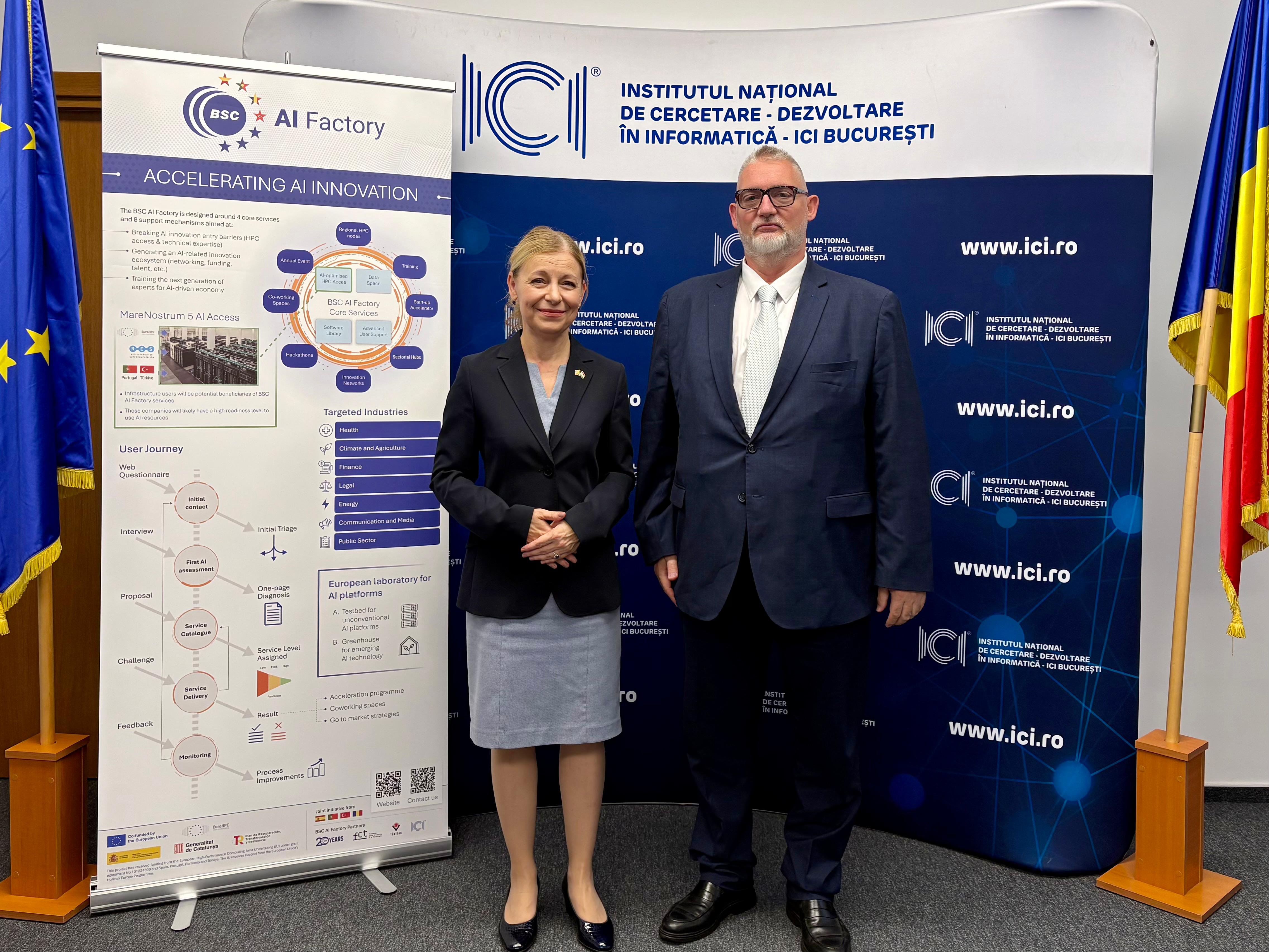
In the context of the partnership between ICI Bucharest and InfoCons, we publish below information material on online safety and consumer protection. ICI Bucharest supports informing users and promoting responsible behaviour in the digital space, by checking sources, being cautious when facing suspicious messages and reporting incidents.
What do the “.ro” registry, blockchain technology, and a free application on your phone have in common? The answer concerns you directly
Trust in the digital space is built on two levels: at the infrastructure level — where researchers and engineers work — and at the citizen level, in the small decisions you make every day. Here is how an application designed for consumer protection trains your reflexes, exactly what a safe information society needs.
The stable functioning of the Internet in the “.ro” space, the security of critical infrastructures, and the development of cloud-based and blockchain-based solutions — all of these are the technical foundation of a knowledge-based economy. It is the daily work of specialists who ensure that our digital ecosystem remains functional and trustworthy. But digital transformation is not built solely on cutting-edge technology: it also depends on each citizen's level of digital education. A system is only as secure as its weakest link, and the most often exploited link remains the hasty or ill-informed person.
This is where a simple but surprisingly relevant tool comes in: the InfoCons app. Free, available in 33 languages and usable anywhere in the world, it is not a research product and does not replace professional cybersecurity solutions. Its role is different, complementary: it brings digital trust to the level of the average citizen. It provides official alerts about dangerous products, lets you check a supplier's legitimacy before paying, and gives you emergency numbers at a single touch. In short, it helps you think like someone who understands how trust works — and how it breaks — in the online environment.
Trust in the digital space is not only built in servers, but also in your pocket
For any citizen who uses online services daily
When you access a ".ro" address, behind that gesture stands an entire infrastructure that ensures you get exactly where you expect: nameservers, databases, and systems maintained with great attention to security and quality. This guarantee of authenticity at the infrastructure level has a counterpart at the individual level: your ability to verify, each time, whether the person you are interacting with is who they claim to be. The InfoCons application embodies this principle in concrete terms. Before paying an advance for a vacation, you can search for a travel agency, hotel, guesthouse, or restaurant by commercial name to find out whether they are authorised and licensed, along with their authorisation status and contact details (this function is available in Romania when the application is set to Romanian). It’s the same logic that underlies an official registry: you don’t trust what’s written in an advertisement, but you compare the information with a verified source. The more citizens adopt the reflex “first I check, then I pay”, the harder it is for attackers to exploit trust — the foundation of any healthy digital ecosystem.
“Smart” does not automatically mean “secure”: how a non-compliant connected product becomes a vulnerability
For anyone filling their home and office with smart devices
The number of connected devices around us is growing exponentially: cameras, routers, smart watches, and home appliances that “talk” to an app. Each of them expands the attack surface — that is, the number of points through which someone with malicious intent could penetrate a network. A product manufactured without minimum security requirements can use default passwords that are impossible to change or transmit data without protection, becoming a gateway. The problem is that this weakness is not visible on the packaging and is not price-dependent. On a large scale, the accumulation of such vulnerable devices can even affect important infrastructures.
The InfoCons application brings you food and non-food safety alerts from the European Union, updated as they appear; for each product, you see the name, the countries targeted, the identified problem and the level of risk. Moreover, if you scan the barcode of a non-food product before buying it, you will immediately find out if it is the subject of a non-compliance alert. For an electronic or connected device, such an alert is a signal worth taking seriously.
The European direction confirms this concern. The Cyber Resilience Act gradually introduces mandatory security requirements for products with digital elements placed on the EU market by 2027. Until these rules become fully operational, informed citizen choice remains an essential line of defence.
The check-before-you-pay reflex: how to avoid ghost stores and cloned pages
For online shoppers and those who book services themselves
A large part of online fraud starts with a page that imitates an official website or a well-known brand almost perfectly. The difference is often a minor detail in the web address or artificial pressure: "offer valid only today", "your account will be blocked". Attackers count on your haste and enthusiasm. The correct answer is informed scepticism — check the source before transmitting data or money, and never enter codes received by SMS on pages opened from unsolicited links.
In addition to checking authorised suppliers, the app also helps you make good decisions as a product user: an important alert about a product can be forwarded, with a single tap, to a loved one. This way, the information that protects you quickly reaches someone who would never have seen it on their own. In cybersecurity, this is exactly how the number of victims is reduced — by quickly disseminating warning information within a community.
Blockchain, but understandable to everyone: what a consumer app and the digital infrastructure of the future have in common
For those curious about how the technologies that are talked about so much work
Blockchain and decentralised storage are, in essence, ways to keep information spread across multiple places, so that it is difficult to alter and lose, and its authenticity can be verified. It is a technology that Romanian research is exploring at the highest level — from decentralised DNS and TLD ecosystems to digital asset platforms (NFTs) for institutions and citizens, developed in a European premiere in collaboration with the private technology sector. For the citizen, the stakes are simple: more transparency, more resilience and more trust in the digital environment.
Surprisingly, the same principle also works discreetly in a consumer protection application. In the InfoCons application, product images and videos are stored using blockchain technology via a decentralised storage solution: files are split into several pieces, kept safe, and reassembled when you access them. You don't have to understand the technology to use it — what matters is that, behind the scenes, the architecture is built transparently. It is a good example of how advanced technologies discussed in research laboratories are already imperceptibly making their way into the tools used daily by hundreds of thousands of people.
A tool for the information society where no one is left behind
For those concerned about digital inclusion and reducing gaps
Romania consistently ranks last in the European Union in digital public services according to the DESI index, and one underlying cause is the unequal distribution of digital skills across the population. Digital transformation only succeeds if it comes with digital education accessible to everyone — including the elderly, disadvantaged communities, and those not used to technology. Otherwise, we risk widening the gaps instead of closing them.
Here, one detail matters enormously: the InfoCons application is not the product of a company that wants to sell you something. It is created and managed by InfoCons, a non-governmental organisation dedicated to consumer protection, a full member of Consumers International, and the information provided is the same for everyone, uninfluenced by any manufacturer. The fact that it works in 33 languages makes it useful even for migrant communities and tourists, categories that are frequently targeted by fraud precisely because of the language barrier. A free, transparent and multilingual tool is exactly the kind of brick that an inclusive information society needs.
From informed citizen to resilient digital ecosystem: what you can do today
For all users: digital resilience is built from the bottom up
A country’s digital resilience is not only the result of infrastructure investments, but also the sum of the good reflexes of millions of users. Every citizen who checks before buying, who reports an attempted fraud or who forwards an alert strengthens the entire ecosystem. Here is a simple plan that you can apply immediately:
- Before buying a connected device (camera, router, smartwatch, toy), scan its barcode and check if it is not targeted by a non-compliance alert.
- Before paying online, check in the app if the supplier, agency or hotel is authorised, and don’t let yourself be pressured by artificial “emergencies”.
- Save the reporting reflex: for any attempted online fraud, call 1911 or fill out the form on pnrisc.dnsc.ro — even if you haven’t lost any money.
- Forward the alerts to the most exposed people around you; a timely warning can stop an entire fraud campaign.
- Treat security as a routine: use unique passwords and a password manager, enable two-step authentication and keep your apps updated.
Digital trust, from infrastructure to citizen
A trusted digital space relies on both ends of the chain: on infrastructures of national interest — such as the National Registry of “.ro” domains and cloud and blockchain solutions developed through research — and on each user's digital education. Accessible tools that foster correct reflexes at the citizen level naturally complement the technical effort to secure the national digital ecosystem.
Where to report a cybersecurity incident
For online fraud attempts, fake pages or compromised devices, rapid reporting limits the damage and helps warn other users:
- 1911 — the national assistance line of the National Directorate of Cyber Security (DNSC), callable 24/7 from any network.
- pnrisc.dnsc.ro — The National Platform for Reporting Cyber Security Incidents (PNRISC).
The InfoCons Solution
Download the InfoCons app for free from Google Play, App Store or AppGallery, set your preferred language and make it a habit to scan products before you buy them and to check any supplier before paying. In a few seconds, you will know if a product is subject to an alert, if an agency is authorised, and who to call if necessary. Correct information, provided by an organisation that works in your interest, is the first step towards safer choices — for you, your family and the digital ecosystem you are part of.
Be informed! Take a stand!
Know your rights and exercise them by calling 021 9615 • *9615 • www.infocons.ro
Source: InfoCons App and InfoCons App Guide – infocons.ro/aplicatia-infocons, infocons.ro/ghidul-aplicatiei-infocons; DNSC reporting channels – 1911, pnrisc.dnsc.ro.InfoCons